
Housman Institute Supports Keeping Migrant Children with Their Parents

Parents are a child’s first teacher and children’s earliest years are critical for their lifelong development, well-being and mental health. The earliest years of life represent the most sensitive and rapid period of brain growth and development. Housman Institute stands together with Infant Mental Health Professionals in Massachusetts who are critically concerned and deeply opposed […]
Dr. Housman Speaks at Harvard University
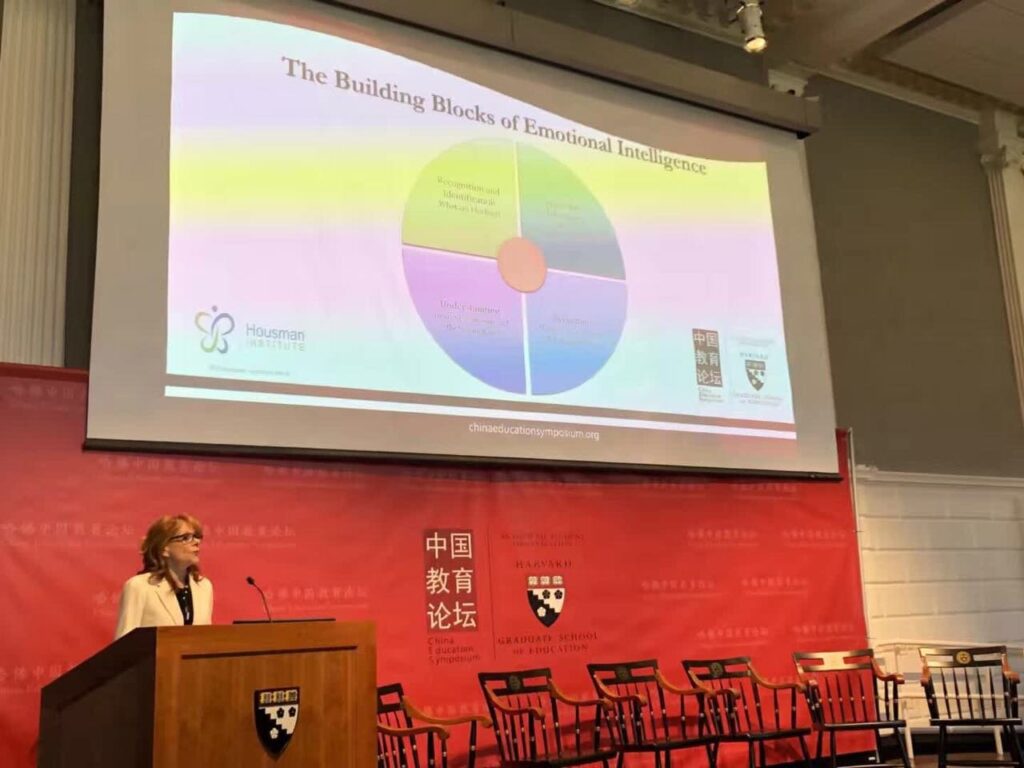
Last May, Dr. Housman spoke at Harvard University’s China Education Symposium on how to effectively promote early learning from birth and how the program she developed, begin to…ECSEL, strengthens foundational emotional, cognitive and social competencies for children’s lifelong learning, success and well-being.
Dr. Housman speaks at Harvard Graduate School of Education

On Saturday, April 21, Beginnings School and Child Development Center Founder Dr. Donna Housman spoke on the importance of emotional, cognitive and social early learning for children’s lifelong well-being and success at 2018 China Education Symposium at Harvard Graduate School of Education, entitled “Where We Started, Where We Are Heading.”
Scaffolding Emotional Intelligence

Happy, sad, angry and afraid. Understanding the Four Primary Emotions: Happy, Sad, Angry, and Afraid These four primary emotions are universal to all human beings, regardless of age. They are a shared, human, and real aspect of our existence. Furthermore, these emotions play a pivotal role in our lifelong learning, well-being, and success. The Importance […]
Co-Regulation on the Pathway Towards Self-Regulation

Caregivers, educators, and policy makers are imperative for young children’s development of emotional, cognitive, and social skills. Specifically, self-regulation—defined by Adele Diamond as the ability to control and manage emotion, cognition, and behavior—is an emotional, cognitive, and social competence essential for healthy growth and development. Self-regulation emerges from co-regulation, whereby caregivers support, instruct, reinforce, and […]
The Importance of Causal Talk in the Emotional Experience (CTEE)

This blog discusses the reasons why Causal Talk (CT) and Causal Talk in the Emotional Experience (CTEE) is important to employ in social, emotional, and cognitive early learning. As early childhood educators, we have a duty to arm children with the skills needed to thrive—most importantly, social and emotional competencies. A powerful way to promote […]
The Art of Nonverbal Communication

Communication allows us to connect with others through expressions of thought, feeling, and desire. We engage with actors on the big screen, empathize with characters in a gripping novel, and lament our friend’s pain as they share their struggles. The combination of words, tone, body language, and touch empower us to convey messages. As young […]
Communication Through Emotion

Children communicate through expressions of emotion, which is our first language universally. Knowing one’s own and others’ emotions, as well as regulating them, is what is known as emotional competence or, in common parlance, emotional intelligence. Caregivers and early childhood educators are crucial in promoting the growth of these skills.
Dr. Housman’s Study on The Importance of Emotional Competence and Self-Regulation from Birth Published in Peer-Reviewed Journal

“Neuroscientific advances demonstrate that the age range from zero to five years old represents a critical window for both learning and teaching, which must involve the development of emotional competence and the growth of self-regulation as a foundation for long-term academic, personal, and social success, promoting mental health and well-being. Recent findings suggest that these […]
The Importance of Emotional Competence and Self-Regulation from Birth

Neuroscientific advances demonstrate that the age range from zero to 5 years old represents a critical window for both learning and teaching, which must involve the development of emotional competence and the growth of self-regulation as a foundation for long-term academic, personal, and social success, promoting mental health and well-being. Read the full research study here!
Supporting Children Through Life’s Inevitable Stressors

Anxiety is a growing issue facing American adolescents today. Benoit Denizet-Lewis, writer for the New York Times Magazine, recently published an article illuminating the pressures facing our youth, depicting gripping personal accounts of anxiety. What was not illuminated is just how young children are being affected. The reality is that children as young as preschoolers […]
Emotional Intelligence Curricula in Massachusetts Schools: Great, But Too Late?

Constructing a foundation of emotional success is now widely understood to provide the building blocks toward academic and life-long success. Nine school districts in Massachusetts, in apparent recognition of the outcomes that such instruction can bring, recently collaborated to implement emotional intelligence curricula for their students. While our state should be commended for being cognizant […]
Teaching the Building Blocks of Emotional Intelligence

The launch of the Housman Institute comes amid growing awareness of the importance of teaching the building blocks of emotional intelligence from birth. Supported through our ongoing research and teacher training, our flagship program begin to ECSEL promotes the growth in early childhood of critical developmental constructs, namely emotional competence, self-regulation, and associated pro-social skills […]